Christian Fiction Writer

Monday

Defiant Heart by Tracey Bateman

This Week Christian Fiction Blog Alliance Introduces
Defiant Heart by Tracey Bateman
Avon Inspire May 8, 2007
ABOUT THE AUTHOR: Tracey Bateman lives in Missouri with her husband and four children. Their rural home provides a wonderful atmosphere for a writer's imagination to grow and produce characters, plots, and settings.

In 1994, with three children to raise, she and her husband agreed that she should go to college and earn a degree. In a freshman English class, her love for writing was rekindled, and she wrote a short story that she later turned into a book. Her college career was cut short with the news of their fourth baby's impending arrival, but the seeds of hope for a writing career had already taken root.

Over the next several years she wrote, exchanged ideas with critique partners, studied the craft of writing, and eventually all the hard work paid off. She has over twenty-five books published in a variety of genres.

Tracey Bateman believes completely that God has big plans for his Kids and that all things are possible to anyone who will put their hope and trust in God!

ABOUT THE BOOK: Will Fannie be able to keep her family...and her heart, safe and find a new life on the frontier? Book One of the Westward Hearts series, orphans Fannie Caldwell and her two young siblings, have spent the last three years as indentured servants under a cruel master.

Desperately wanting a better life for her brother and sister, Fannie devises a plan to secretly join a wagon train heading west. Her plan immediately runs into trouble when the handsome, yet bullheaded, wagon master Blake Tanner refuses to allow an unmarried woman on the train. But Fannie's determined...she'll escape and go west with or without help!

As life on the trail tests everyone's endurance and faith, Fannie soon realizes the perils of being a single woman on the frontier. Witnessing Fannie fend off one scare after another, Blake slowly recognizes how much he cares for this alluring young woman.

Will Blake sacrifice his own dreams and guide Fannie to safety? Or will Fannie's stubborn independence keep her from finding true love?

Wednesday

Tribulation House by Chris Well


EXTRA! EXTRA! READ ALL ABOUT IT! An extra special post is coming out
today, May 11th, for
an extra special author. The man who started to ball rolling for FIRST,
Chris Well, has a new book out and we have decided to give him an extra
plug.


So, give all your attention to:


Chris
Well

and his
book:

TRIBULATION
HOUSE

(Harvest House 2007)

ABOUT THE AUTHOR:

Chris Well is founder of FIRST. He is
an acclaimed novelist and award–winning magazine editor and has
previously written the “laugh–out–loud Christian thrillers” Deliver Us from
Evelyn
and Forgiving Solomon Long(one of Booklist’s Top 10 Christian Novels of
2005). He has also contributed to 7ball, Infuze, and Alfred Hitchcock’s
Mystery Magazine. Chris and his wife live in Tennessee, where he is
hard at work on his next novel.


AND NOW...THE FIRST
CHAPTER:


~1~


I might as well just tell you right now, I killed Reverend Daniel
Glory. Back there at the church, in his study.

But this is my story. Don't let anyone tell you different. My dad
always said we all write our own story. Of course, I guess that's why it
worked out so well for him.

Why did I kill Reverend Daniel Glory? Sure, it was an accident. More or
less. At least, I think it was.

I don't know, we were arguing about the Rapture and it kind of got out
of hand and then I just --

Wait. Wait. I'm getting ahead of myself. Let me back up.

This all started about three months ago, when Reverend Daniel Glory
told us we needed to do our Tribulation House earlier than --

Oh. Wait.

Okay, I guess this actually started last year when Marvin Dobbs left
the church. Our church. The Last Church of God's Imminent Will.

A year ago last summer, Marvin left with some of the other families to
start a new church, and he took his Armageddon House" multimedia show
with him.

You do know about Armageddon House, right? Every Halloween for the past
three or four years, Marvin and our team put together a special
multimedia presentation explaining the Great Tribulation, which ends with the
Battle of Armageddon.

Wait -- you don't know about the Great Tribulation? It's that
seven-year period between the Rapture and the Triumphant Return of Jesus Christ,
as described in the prophecies of Daniel and Ezekiel and the Apostles
Paul and John. After the Lord Jesus takes His Bride home, there are
going to be seven years of horrible judgment inflicted on those who are
left b --

What? The murder of Reverend Glory? I'm getting to that.

Well, anyway, when Marvin left to form his little offshoot splinter
group, we discovered he had actually trademarked the name "Armageddon
House." Imagine that.

When the board at church met to discuss the matter, we considered doing
Armageddon House anyway without him. Just reconstruct it from memory
and copy or use materials from previous years. Use the same name,
business as usual. Just ignore the cease-and-desist letter, let God and His
angels work that out.

But we decided we didn't want to be associated with Armageddon House
anymore. I mean, if Marvin and his new "fellowship" planned to stage
their own Armageddon House, the risk of confusion in the marketplace was
enough to rebuild ours as a brand-new event.

Which is how we ended up with Tribulation House. It was an opportunity
for a new beginning. We went through a whole list of potential names --
I came up with Kingdom Come, but was voted down -- before we settled on
Tribulation House.

We sat down and worked through the whole grid. Instead of imagining how
to simply explain or show a picture of each bowl of wrath and each
trumpet of judgment, we created an entire theatrical event.

Yeah, we could have set up the charts and graphs and the overhead
projector. But today's audience, this last generation, they're kind of jaded
about flannel graph presentations, know what I mean?

These kids today, with their Spongebob Squarepants and their
American Bandstand and their Buffy The Vampire Slayer,
they need the bells and whistles and the like.

The kids don't need a lot of explanation. They need a demonstration.

You see, that was the challenge, wasn't it? It's one thing to say "the
moon was blackened" or "the waters turned to blood" or "men were stung
by enormous flying scorpions" -- but how do you make it happen right
here, right before their eyes?

In the end, we created Tribulation House: A full-sensory immersive
interactive dramatic theatrical evangelistic event that simulates what it
will actually be like to live through the events of the Great
Tribulation. An entire full-service prophetic experience.

You'd be surprised how much of it we accomplished with sound and light.
We developed the various rooms throughout the church basement. Some
college kids created soundscapes for each event. We wrote up a full script
for the actors; they played everything from people caught up in the
events, to the world armies fighting the Most Holy, to the father of lies
himself, bound and thrown into the pit for a millennium.

The murder of Reverend Daniel Glory? I'm getting to that.

So we were working out the blueprints for creating Tribulation House as
a major theatrical evangelistic full-sensory ministry outreach. We had
debated the merits of various slogans for the event -- the leading
contenders were WE'LL SCARE THE HELL OUT OF YOU; GET RIGHT OR GET LEFT; and
THE TIME IS CLOSER THAN YOU THINK. While the first slogan was a
favorite of several board members, for its bracing, truthful stance, in the
end we worried that the neighbors would misunderstand. So we went with
the second slogan, for its simple, instructional message.

And I remember that our chief carpenter, Bill Broadstreet, was giving
us his estimate for the physical construction to be done on the project.
Suddenly, Reverend Daniel Glory burst in with some news.

"Friends!" There was a glow on the Reverend's face unlike we had seen
before. The man stood there in the doorway to the church basement,
leaning against the doorframe, wheezing to catch his breath. "Jesus is
coming back!"

The room was silent. We all stared. At first, we wondered why he was
saying this right then. After all, he preached on this topic every week.
But then he dropped this bomb: "And I know when!"

Okay, that was a new one. Collectively, everyone in the room gasped.
One of us, I don't even remember who it was, asked, "When, Reverend?"

"October 17."

Five months.

"5:51 a.m." Reverend Daniel Glory waved the papers clutched in his
hand. Later, I would wonder what he was waving at us. His Bible study? His
calculations? All I know is he grinned ear to ear and said, "The
Rapture is going to happen at 5:51 a.m. on October 17."

Everyone around the meeting table reacted differently. Some were
stunned into silence, others screamed with joy. One noisy woman loudly sobbed
and clapped.

Reverend Daniel Glory came into room, face aglow with thrill and
exhaustion, and dragged a chair from the wall over to our table. He sat,
waiting until everyone was silent again. "I now have incontrovertible proof
that the Rapture takes place this coming October."

I'm sure I grinned bigger than anyone in the room. "What reason do you
have to say that?"

Reverend Daniel Glory looked at me and winked. "Why stop with one
reason, boy? I got one hundred and seven of 'em!"

Of course, you know what this meant. We were going to have to step up
the production of Tribulation House.

(I still can't believe it's not Kingdom Come.)


Tribulation House earlier than --
Oh. Wait.
Okay, I guess this actually started last year when Marvin Dobbs left
the church. Our church. The Last Church of God's Imminent Will.
A year ago last summer, Marvin left with some of the other families to
start a new church, and he took his Armageddon House" multimedia show
with him.
You do know about Armageddon House, right? Every Halloween for the past
three or four years, Marvin and our team put together a special
multimedia presentation explaining the Great Tribulation, which ends with the
Battle of Armageddon.
Wait -- you don't know about the Great Tribulation? It's that
seven-year period between the Rapture and the Triumphant Return of Jesus Christ,
as described in the prophecies of Daniel and Ezekiel and the Apostles
Paul and John. After the Lord Jesus takes His Bride home, there are
going to be seven years of horrible judgment inflicted on those who are
left b --
What? The murder of Reverend Glory? I'm getting to that.
Well, anyway, when Marvin left to form his little offshoot splinter
group, we discovered he had actually trademarked the name "Armageddon
House." Imagine that.
When the board at church met to discuss the matter, we considered doing
Armageddon House anyway without him. Just reconstruct it from memory
and copy or use materials from previous years. Use the same name,
business as usual. Just ignore the cease-and-desist letter, let God and His
angels work that out.
But we decided we didn't want to be associated with Armageddon House
anymore. I mean, if Marvin and his new "fellowship" planned to stage
their own Armageddon House, the risk of confusion in the marketplace was
enough to rebuild ours as a brand-new event.
Which is how we ended up with Tribulation House. It was an opportunity
for a new beginning. We went through a whole list of potential names --
I came up with Kingdom Come, but was voted down -- before we settled on
Tribulation House.
We sat down and worked through the whole grid. Instead of imagining how
to simply explain or show a picture of each bowl of wrath and each
trumpet of judgment, we created an entire theatrical event.
Yeah, we could have set up the charts and graphs and the overhead
projector. But today's audience, this last generation, they're kind of jaded
about flannel graph presentations, know what I mean?
These kids today, with their Spongebob Squarepants and their
American Bandstand and their Buffy The Vampire Slayer,
they need the bells and whistles and the like.
The kids don't need a lot of explanation. They need a demonstration.
You see, that was the challenge, wasn't it? It's one thing to say "the
moon was blackened" or "the waters turned to blood" or "men were stung
by enormous flying scorpions" -- but how do you make it happen right
here, right before their eyes?
In the end, we created Tribulation House: A full-sensory immersive
interactive dramatic theatrical evangelistic event that simulates what it
will actually be like to live through the events of the Great
Tribulation. An entire full-service prophetic experience.
You'd be surprised how much of it we accomplished with sound and light.
We developed the various rooms throughout the church basement. Some
college kids created soundscapes for each event. We wrote up a full script
for the actors; they played everything from people caught up in the
events, to the world armies fighting the Most Holy, to the father of lies
himself, bound and thrown into the pit for a millennium.
The murder of Reverend Daniel Glory? I'm getting to that.
So we were working out the blueprints for creating Tribulation House as
a major theatrical evangelistic full-sensory ministry outreach. We had
debated the merits of various slogans for the event -- the leading
contenders were WE'LL SCARE THE HELL OUT OF YOU; GET RIGHT OR GET LEFT; and
THE TIME IS CLOSER THAN YOU THINK. While the first slogan was a
favorite of several board members, for its bracing, truthful stance, in the
end we worried that the neighbors would misunderstand. So we went with
the second slogan, for its simple, instructional message.
And I remember that our chief carpenter, Bill Broadstreet, was giving
us his estimate for the physical construction to be done on the project.
Suddenly, Reverend Daniel Glory burst in with some news.
"Friends!" There was a glow on the Reverend's face unlike we had seen
before. The man stood there in the doorway to the church basement,
leaning against the doorframe, wheezing to catch his breath. "Jesus is
coming back!"
The room was silent. We all stared. At first, we wondered why he was
saying this right then. After all, he preached on this topic every week.
But then he dropped this bomb: "And I know when!"
Okay, that was a new one. Collectively, everyone in the room gasped.
One of us, I don't even remember who it was, asked, "When, Reverend?"
"October 17."
Five months.
"5:51 a.m." Reverend Daniel Glory waved the papers clutched in his
hand. Later, I would wonder what he was waving at us. His Bible study? His
calculations? All I know is he grinned ear to ear and said, "The
Rapture is going to happen at 5:51 a.m. on October 17."
Everyone around the meeting table reacted differently. Some were
stunned into silence, others screamed with joy. One noisy woman loudly sobbed
and clapped.
Reverend Daniel Glory came into room, face aglow with thrill and
exhaustion, and dragged a chair from the wall over to our table. He sat,
waiting until everyone was silent again. "I now have incontrovertible proof
that the Rapture takes place this coming October."
I'm sure I grinned bigger than anyone in the room. "What reason do you
have to say that?"
Reverend Daniel Glory looked at me and winked. "Why stop with one
reason, boy? I got one hundred and seven of 'em!"
Of course, you know what this meant. We were going to have to step up
the production of Tribulation House.
(I still can't believe it's not Kingdom Come.)


Well's style is entertaining, a tad-bit "cheeky,"and extremely funny. His satirical, but gentle, treatment of modern-day evangelical/fundamentalist/pentecostalist's rather in-bred, sometimes glaringly-blind-spots is good medicine for the Church body. Chris Well is not disrespectful, not irreverent; his comedic enema will move many of us to do some serious reflection--after we stop laughing, that is. Recommended.

Monday

The Alexandria Link

Also posted at Infuzemag.com


In Steve Berry’s The Alexandria Link, the real Abrahamic Covenant—that is, before it was altered by Jewish and Christian agenda-driven translators—is about to be unearthed. An international finance cartel, some power-hungry politicians, and a few hired assassins race to find the lost Library of Alexandria and seize its extant Hebrew manuscript that declares the original site of the Promised Land. He who holds the Covenant controls the political future of the Middle East.

Although The Alexandria Link is a stand alone novel, Berry’s character Cotton Malone, returns from The Templar Legacy. Malone, who Berry says thinks and acts a lot like him, is a middle-aged, government intelligence officer tired of the agency. Malone’s hysterical ex-wife shows up on his doorstep in Copenhagen, where he owns a rare book shop, announcing the kidnapping of their teenage son. She hands Malone a cryptic note of instructions: the kidnappers hope to force him to reveal the hiding place of George Haddad, a Palestinian Bible scholar, who they believe can lead them to the ancient library. The kidnappers attack Malone’s shop, engulfing it in flames to urge him into action—his angry ex-wife in tow.

Malone, while protecting his ex-wife and locating his kidnapped son, must keep Haddad’s location secret and reach the Library before the bad guys; but can Malone trust the tag-along mercenary who saved his life? Can he trust his government, his ex-agency or his ex-wife?

Berry’s themes of corrupt organized religion and power politics play out in this fast-paced, international suspense to find the ancient world’s greatest library. Destroyed before the seventh century, it held the Hebrew text believed to have been the source for the Septuagint, the first Greek translation that became the source for the Latin Vulgate.

The Catholic Church’s history, rife with corrupt priests in powerful positions, plays negative roles in his novels. But, Berry, a Catholic, says his aim is to entertain—not offend his religious readers; and Berry emphasizes that The Alexandria Link is fiction, not fact.

With that said, however, The Alexandria Link promises to be as controversial as Dan Brown’s The Da Vinci Code. In fact, Brown endorsed Berry’s book. And like The Da Vinci Code, The Alexandria Link won’t be appreciated by readers offended by controversial treatment of Biblical subjects.

While The Da Vinci Code speculates on the romantic relationship (groundless) between Jesus and Mary Magdalene, The Alexandria Link is based on revisionist history that is hostile to Israel in the age-old Palestinian-Israeli land squabble.Berry credits Kamal Salibi’s book, The Bible Came from Arabia, for the idea to write The Alexandria Link.

Revisionists like Salibi, a Lebanese historian, claim that Jews and Christians intended to cement Israel’s Biblical and historical claim to Arab lands, and tampered with Scripture while translating it. Haddad, Berry’s fictional Bible scholar says, “What if the Old Testament, as we know it, is not, and never was, the Old Testament from its original time? Now, that could change many things.”
Haddad, along with Salibi, believes that Israel’s Biblical history occurred someplace other than Palestine: “Archeologists have dug in the Holy Land with a vengeance all to prove the Bible as historical fact—not one shred of physical evidence has been unearthed that confirms the Old Testament—nothing found to prove it—an evidentiary void,” says Haddad.

Berry supplies a “writer’s note” to separate fact from fiction in The Alexandria Link, and this is where my criticism lies. Berry acknowledges that the “idea that the land promised by God in the Abrahamic covenant lies in a region far removed” from modern-day Palestine is controversial. But, Berry agrees with Salibi that archaeology could “easily prove or dismiss” the premise

Yet, he fails to mention the myriad archaeology—the Dead Sea Scrolls, the discovery of King David’s palace, and the walls of the First Temple, to name a few—that refute Salibi’s and Haddad’s claims. Hershell Shanks, editor of "Biblical Archaeology Review," describes the Dead Sea Scrolls found in caves near Jerusalem in 1947: "The oldest Hebrew texts were two manuscripts from the 10th or possibly the early 11th century known as the Aleppo Codex and the Leningrad Codex” The Qumran texts date a thousand years earlier, before Biblical texts were standardized.

The Qumran Texts are Biblical texts, written between 250 BC and 68 AD, when the Romans destroyed the settlement.The caves held 800 texts written more than 2000 years ago, which included all the Old Testament books except for Esther, and confirmed the Septuagint translation as reliable. So, when Haddad underscores his point to Malone by saying, “The oldest surviving Hebrew Bible [was] produced nearly 2000 years after the original text from who knows what?” Perhaps he should consult the Dead Sea Scrolls.

Haddad also questions the lack of physical evidence to support the Old Testament. He says, “Archaeologists have found not one shred of physical evidence” to confirm the Old Testament as fact. But, apparently he hasn’t heard that since 2005 archaeologists have found King David’s palace, which dates to the 10th century BC, near the walls of the Old City or that a First Temple wall has been uncovered in Jerusalem’s City of David.

The Alexandria Link is a well-written, suspenseful high-speed chase—good guys versus bad with guns blazing—to seize control, ultimately, of Israel’s future. Berry’s interesting characters and research of locales in Denmark, Portugal and D.C. add dimension and credibility to the novel. However, as Berry notes, “the final story is a blend of fact and fiction.” The Alexandria Link is excellent fiction. But, in order to draw the line between historical of fact and Berry’s fiction, readers will need to rely on their own research, rather than depend on Berry’s.

The Unnatural History of Cypress Parish by Elise Blackwell

While Hurricane Katrina’s baleful eye bores down on the Gulf Coast and newscasters call for mass evacuation, predicting inundation of New Orleans, time pauses for Louis Proby. Perceiving the irony of his fate, Louis remembers another calamity: the 1927 flood when “men with money and the power to change things” persuaded Louisiana’s governor to order the levee protecting his home town, Cypress Parish, dynamited to save New Orleans.

The weather reports fade to the background as Louis opens a binder containing his research of Cypress Parish’s natural history. He recalls his youthful innocence and idealism, and their loss before his 17th birthday — all part of life before the flood. But, mostly Louis remembers loving Nanette Lancon.

Blackwell’s literary novel, The Unnatural History of Cypress Parish, is based on fact. She credits John M. Barry’s Rising Tide, and her grandfather’s unpublished memoirs as history sources for her narrative that examines the poor and powerless of Cypress Parish pitted against the rich and powerful of New Orleans at the approach of impending disaster. “If you want to understand how something works… threaten that society… and its true nature will reveal itself,” writes Barry. That hypothesis is the core of Blackwell’s Cypress Parish.

Louis Proby narrates a dismal reality of people living in dirt poverty compounded by instinctive shame in "where they came from.” He tells of “men whose names mattered before the flood” inviting him to their world of money and power; a world of uneducated men wise in wisdom gained from experience; and a world of racism and hard-won friendship. He tells of his family and the parish people whose lives were changed forever — disrupted by the flood.

Blackwell’s literary gift lies in her ability to create a sense of place that comes from growing up “south of south” in Louisiana. Louis explains, “Who I am remains intimately gnarled with where I came from.” He sees himself and the land as one, “marked by the conditions where the tree was grown.” Elise Blackwell’s writing is steeped in the same rich soil.

The cypress tree symbolizes the parish and Blackwell’s themes of loss, destruction and life disrupted by man’s short-sighted intervention. Louis says: "The most important thing I had written, I understood, was that the bald cypress could live three-thousand years. It takes more than a century for a cypress tree to mature enough to produce good lumber; today cypress is mostly harvested young and sold as mulch."

Blackwell’s characters are hauntingly memorable. They change the way trees change that have endured the onslaught of decades of harsh weather — change that scars more than grows; but, perhaps on a deeper level survival is growth. Louis is like the Cypress tree, he survives. Now on the eve of Hurricane Katrina at age 95, he remembers his unfinished life in Cypress Parish, and he regrets that he didn’t say good-bye to Nanette.

Aside from the sheer enjoyment of reading Blackwell’s writing, I grew in my understanding of humanity through Cypress Parish. I recommend it highly.

You can read original reporting of the 1927 Flood at Time Archives and experience original voices and graphics of the flood at PBS Fatal Flood of 1927. You can also listen to Unbridled Aloud Podcasts.

On writing "The Unnatural History of Cypress Parish," Blackwell said:


My fictional Cypress Parish is a combination of St. Bernard Parish (where the 1927 levee breech occured), Livingston Parish (where my grandfather grew up) and Vermillion Parish (where my grandfather wooed my grandmother away from a house of pretty French sisters).

When I was a kid, my grandfather saw that I liked to write and offered to pay me a dollar a story. When I became too prolific for his wallet, he told me to keep writing but not for money. Late in his life, he picked up a pen of his own and started chronicling his years growing up in rural Louisiana as well as his later experiences in war, study, and life. He did this not with an eye toward publication but so that his grandchildren would know him better, would know more family history. He gave us the new chapters every Christmas, the white copy-shop boxes sitting under the tree with our other presents. He wrote these memoirs on a cypress desk and under a lumber company map of the parish where he grew up. It would take me a long time to get around to this material, but the image stayed with me. I knew from the start that desk and map would sneak into the novel.


Blackwell's debut novel is Hunger. She is on the English faculty at The University of South Carolina.


The Unnatural History of Cypress Parish, Elise Blackwell, Book, Not yet published
Hunger, Elise Blackwell
Rising Tide: The Great Mississippi Flood of 1927 and How It Changed America
John M. Barry

Wednesday

A Bigger Life, by Annette Smith

Christian Fiction Blog Alliance
Introduces A BIGGER LIFE
by Annette Smith

About Annette Smith: 1997, Annette worked as a home health nurse. She traveled the back roads house to house, caring for the ill, injured, and homebound. Because of her unique position in the lives of relative strangers, she often found herself bearing solitary witness to intimate behind-the-scenes situations full of grace and meaning.
Annette's desire to honor both a particular patient, and a poignant scene involving the woman and her husband, prompted Annette to write a fictionalized story, The Anniversary.

The story ran as a column in the Houston Chronicle, and as an essay in Today’s Christian Woman. Later, it became a chapter in Annette’s first, and best-selling, book of short stories, The Whispers of Angels, which sold more than 100,000 copies.

Since then, Annette has penned four more books of stories, two volumes on parenting, and the Coming Home to Ruby Prairie trilogy.

Annette and her husband Randy, a High School teacher and coach, make their home on a wooded lot in Quitman, Texas. They are the parents of two young adult children, Russell and Rachel, both out on their own. Wally, a grateful, rescued mutt provides warmth and entertainment, and keeps the Smith’s empty nest from feeling too lonely.
In addition to writing, Annette continues to serve part-time as a registered nurse. She finds the people she works with and the patients she cares for provide great inspiration for her fiction

ABOUT THE BOOK: Joel Carpenter did not plan for his life to turn out like this. He never meant to be a single dad, working at a hair salon in Eden Plain, Texas. But after making a careless choice four years ago, his marriage was permanently shattered. Now at twenty-seven, he finds himself juggling custody of his preschool son with Kari, the ex-wife he still loves, and sharing Sunday dinners with a group of other single dads. Joel regrets the choices that brought him to this place, but it's not until the worst happens that he learns how much he still has to give. In the midst of deep tragedy, he learns that forgiveness is way more important than freedom. Hopefully it's not too late!A BIGGER LIFE is a story of love in the midst of heartache, and friendship in the midst of real, everyday life.

Sunday

Wishing on Dandelions, by Mary E. DeMuth


It is April 1st,
time for the FIRST Day Blog Tour! (Join our alliance! Click the button!)
The FIRST day of every month we will feature an author and his/her
latest book's FIRST chapter!


This month's feature is:


Mary E.
DeMuth

and her book:

Wishing on Dandelions

(NavPress
Publishing, 2006)

ABOUT THE AUTHOR:

This month's feature is very special. The author is
one of the FIRST Day Blog Alliance Members!!! Click here for her Blogspot! MARY E. DeMUTH has spent the
last fifteen years as a writer. Winner of the 2003 Mount Herman
Christian Writers Conference's Pacesetter's Award, she now splits her time between writing and planting a new church with her husband, Patrick, and two other families.

Wishing on Dandelions is the second book in the Maranatha Series. The first was the critically praised book, Watching the Tree
Limbs
. She has also written two parenting books. Building the
Christian Family You Never Had
and a new one called Authentic
Parenting in a Postmodern Culture
which will release this
summer with Harvest House. Mary, Patrick, and their three children make
their home in Texas.

DeMuth honestly describes the shame and guilt that abuse victims often own and use against themselves, a self-view that can only be made whole by seeing themselves through God's love. Wishing on Dandelions is beautifully written.


AND NOW...THE FIRST CHAPTER:
I n t r o d u c t i o n
I still can’t tell my story up close, like it was me in
it,breathing the tangled wisteria on the fence posts of Burl, Texas. There
are times I still can’t bear to say it was me. The book of mylife
continues to open, painful word by painful word, page after page. I get real
close to typing the whole story with the word I in it, but I hit delete
every time, replacing me with she.
Zady tells me I’m ready to write my story honest, but I’m not so sure.
She says she’s there to help me remember my healing,even as she puts an
arm around my shoulder when a tear slips through. “It hurts,” she says.
“Real bad. Lord, I wish it didn’t rip at you so.”

She tells me I survived that story — that I should be proud — yet her
presence brings back its horrid validity written on the backdrop of her
tender love. Reminds me in a kind, wild way that this is my
story even if I can’t seem to admit it on the page.

***

Summer 1983
Burl, Texas

Uncle Zane appeared disheveled when Maranatha pestered
him. His silvery hair, normally combed and parted in the exact
same place, was instead bunched and unkempt, his part like a
winding Burl road.

“Camilla and me, well, we want to go to the fair. Can you drive us?
Please?” Maranatha practically danced, shifting her weight from one foot
to the other.

“No,” he shouted, an odd outburst for such a quiet man.

Gangly and with a sinewy will of her own, she pled, “C’mon,Uncle Zane.
Everyone will be there. Besides, Camilla promised we’d shoot the fair —
ride every single ride from the merry-goround to the Zipper. This year
I promised her I’d do it without getting sick.”

“I said no.”

Three plain words. Maranatha almost turned away in a thirteen-year-old
huff, but she lingered long enough to see him sit down in a parlor
chair, then bend forward, pressing palms to temple.

“We’ll ride our bikes,” she told him. The room echoed her words. “I’ll
be back later.” Her words stung even as she said
them, particularly because Uncle Zane, usually a man without
reaction, looked up at her with a strange sort of look in his blue
eyes. A look that pleaded, Please stay.

She left him there. And didn’t look back.


***

Camilla and Maranatha raced down the road toward the embrace of the
fair, miles away. “You’re going to barf on me, I know it,” Camilla teased.

“I will not. My stomach’s better.”

“Oh, right. Now that you’re a teenager, you’re not nauseous? If I were
you, I’d be cautious. I don’t trust your stomach. Neither should you.”

They raced, tire to tire, until Camilla saw a wrought-iron gate and,
behind it, a burnt skeleton of a house. “I smell mystery,” she said. She
stopped her bike. Maranatha nearly crashed into her.

In lieu of a ride on the Tilt-a-Whirl, and despite Uncle Zane’s pained
blue eyes, Maranatha and Camilla climbed over the gate. They searched
the scorched scene, pretending to be arson investigators.

They concluded a cat had set fire to the house, taking feline revenge
on an evil master. “All scary houses have names. This one’s Black, sure
as night,” Camilla said.

As the day’s shadows lengthened, after they’d explored the woods behind
the house whose once-grand pillars stood charred against the Texas sky,
Camilla said, “I want to come back here another day.” She put her hands
on her hips and tilted her head back. “Let’s go back to Black.” She
wailed and screamed the words like AC/DC. Maranatha laughed so hard, she
nearly wet her pants.


***

Maranatha and Camilla never made it to the fair.

Tired from their investigating, they pedaled lazily back to town. “I’ll
see you soon, baboon.” Camilla waved a good-bye to
Maranatha.

Something niggled at Maranatha as she walked the stairs of the big
white house. Everything looked the same, but nothing felt that way.

“I’m home, Uncle Zane.” Her voice echoed, bouncing off tall ceilings.
She called Zady’s name, though she knew it was unlikely the housekeeper
would be there on a weekend. She shivered. Loneliness pierced her.

She walked past the parlor to look out the kitchen window at Uncle
Zane’s parking spot, figuring he’d probably left to look for her — again.
He had swung on a wild pendulum from disinterest to overprotection the
day her name changed from Mara to Maranatha three years ago, but his
protection kicked into high gear when she turned thirteen. On her
birthday, he gave her a bike that sported a crudely shaped bow. He handed her a
hockey helmet. “Be careful,” he said. And he meant it.

She stopped in front of the window. Uncle Zane’s white Cadillac sat
silent in the driveway, the same place it’d been when she’d ridden away
earlier.

Panic ripped through her.

Maranatha ran to the parlor. On the floor, Uncle Zane lay prostrate,
face kissing the oriental rug, arms and legs outstretched like he was
making a prone snow angel.

“Wake up,” she wailed.

But he didn’t. An ambulance came and whisked him away, while the word
stroke hung in the hot Burl evening.

***

Zady’d tried to soothe Maranatha during his long rehabilitation. “It’s
not your fault, Natha,” she said. “I should’ve checked on him. He
seemed altered, and I should’ve known.”

Though Zady wore guilt in the lengthening lines around her eyes, she
pestered Maranatha with all sorts of don’t-blameyourself words,
meaningless blather that never made it past Maranatha’s terrible heart. The best
way Maranatha could explain it to Camilla was that she and Zady stood
before a giant chalkboard, with the words should have and could have
scrawled over and over again like naughty kids’ sentences. While Zady
tried to erase Maranatha’s coulds and shoulds, Maranatha rewrote them line
by line.


O n e

Summer 1987
Burl, Texas

Every year on the anniversary of his stroke, and many times in
between, Maranatha retraced the route she and Camilla had ridden that day.
In front of her bike tire beckoned a serpentine of gray pavement
radiating heat. The more her shirt clung to her body in a sticky embrace, the
better she liked it.

Penance.

She’d learned the word from Bishop Renny. He said something about
trying to make things right by abusing yourself. Said Jesus took the need
for all that away. But she knew Jesus would say something different to
her, considering how she’d nearly killed Uncle Zane because of her
selfishness.

The hot Burl breeze tangled Maranatha’s hair so that it whipped and
wrangled about her face. She didn’t mind, didn’t even brush a casual hand
to her face to clear the hair from her eyes. At seventeen, she welcomed
the wildness, wearing her tangles like a needed mask. A gust of
sideways wind whipped the mask from her face.

Maranatha passed the costume shop where, behind a cracked front window,
one headless mannequin sported a faded Santa suit and another, a
sequined Twenties dress. She pedaled past the farm implement shop whose yard
was dotted with ancient rusty plows. This strip of road held most of
Burl’s broken dreams — a turn-of-the-century white farmhouse, now
converted into a bed and breakfast that no one visited, a handpainted For Sale
sign declaring the dream dead. A mobile home stood way back on a fine
piece of property, the structure tilted oddly to the left where the
cement blocks had deteriorated. A goat preened on its roof, claiming it for
himself. Four years ago, children had played out front. She and Camilla
had even waved to them. So carefree for such a day.

Wiping the sweat off her forehead with the back of her hand, she
glanced down at the too-small bike, despising it, as if it had once held her
hostage, carrying her away from Uncle Zane’s need four years ago when
she and Camilla had been drawn toward the lure of cotton candy and
caramel apples.

Maranatha veered onto the familiar gravel driveway flanked by crepe
myrtles. She stopped, straddling her bike, catching her breath. She
listened for cars but heard only the labored noise of a tractor, far away,
until the engine sputtered and died.

The silence roared at her.

It should have blessed her with peace; instead, she remembered Uncle
Zane’s hair askew and wondered why God let a selfish girl like her take
up space in this world.

She looked behind her. Her thoughts shifted as a deeper worry played at
her, taunting her. Though she never voiced it, she lived with a
constant fear that someone would burst from the silence and grab her. She
hated that she always looked behind, like she was expecting some crouching
phantom to nab her. She’d been running from monsters bent on destroying
her ever since General first drawled, “Hey, Beautiful” in her ear. Even
though she was sheltered in Uncle Zane’s white house and safety was no
longer elusive, she always felt the presence of evil five steps behind
her. Ready to suffocate her.

She glanced at her wrist to soothe her fears. Circling it was her name,
maranatha, each sterling letter separated by a bead. Zady’d given it to
her a year after she found out that her real name wasn’t Mara but
Maranatha. Part of her quest in discovering her identity was a need for a
name that meant more than “bitter.” When she learned that her real name
meant “Come, Lord Jesus,” a part of her heart enlivened, as if it knew
she was named that all along. She touched each letter, thanking God that
He added Natha to the end of her name, that He changed her from bitter
to a heart where Jesus could live. If He wanted to, that is.

She got off her bike. The same wrought-iron gate stood erect before
her, chalkboard black and foreboding, with an out-of-place silhouette of a
squirrel at its arched top. It always reminded her of Willy Wonka’s
gate, the gate that prohibited children from seeing the mysteries within
the glorious Chocolate Factory. She laid her bike in its familiar dusty
place behind the crepe myrtles
and approached the gate. Locked.

As usual.

Heart thumping, she tried the handle, a ritual she performed every time
she ventured to this place, the scene of her selfishness. Why she
thought it would magically open today, she didn’t know. When she tugged at
it, the gate creaked a warning, but it didn’t budge. Looking back toward
the road, she listened again. Nothing. Only the sound of a dove calling
to its lover and the crackle of too-dry grass rubbing against itself
like a fiddle against its bow. She breathed in the hot air and touched
the angry wrought iron. She returned to the bike, unzipped the pouch
behind her seat, and stretched on her bike gloves. Attacking the gate
again, she pulled herself up, up, up until she could swing her leg over the
gate’s pointed top. She scampered down, preferring to jump the last
three feet.

Maranatha smiled. Before her was an open field whose hair was littered
with dandelions past their prime. Bits of dandelion white floated in
front of her like an idle snowfall, only these flurries drifted toward
the sun, away from the ground, in lazy worship. Beyond the field stood
the remains of the charred mansion.

Now shaded by the house’s pillars, she remembered Uncle Zane’s eyes the
day of his stroke. The smile left her face.

She ran to the middle of the field, trying to shake the memory — her
laughing, laughing, laughing while Uncle Zane pled for her. She stopped.
Maranatha picked one dandelion, held it to her mouth, and blew a warm
breeze over its head, scattering wishes toward the has-been mansion.
Jesus, You know my name. I want to live up to it. I want my heart to
be a place where You want to come. But I’m afraid it’s too dark there.
What I’ve done. What’s been done to me. . . . I’m sorry I’m so needy,
but I have to know, have to know it in my gut. Please show me You love me
anyway. Whatever it takes.


It had been her wish since she met Jesus under the pecan tree at her
home, back in the days when Uncle Zane had a quiet will and Zady, his
housekeeper and her friend, kept house without the intrusions of
Georgeanne, who had invaded their peaceful home with her schemes. Zady dished
out helpings and helpings of His love every day at Uncle Zane’s table,
but Maranatha never seemed to be able to digest even a scrap. She
experienced Jesus at church, surrounded by Mama Frankie and faces darker than
her own. When dark-skinned Denim spoke or his pale-faced stepdaughter
Camilla rhymed truth, Maranatha thanked God for making unique folks, for
giving her friends. Still, Jesus’ love seemed far away, and she,
undeserving.

A portion of her little girl’s heart had been abducted by General, the
boy-turned-man who violated her so many years ago. His pocked face
visited her in nightmares where she had no voice, no safety, no escape. He
seemed to lurk behind every stray noise. He didn’t haunt Burl anymore,
but he lived firmly in her mind, igniting dread. She feared he’d stolen
the only part of her that could have understood God’s love. She feared
he held the middle piece to the puzzle of her life.

Am I wishing for something I’ll never have?

Maranatha shielded her eyes from the pursuing sun and walked toward the
burnt house. Four once-white pillars stood tall, blackened by angry
flames. She remembered when she’d first seen Uncle Zane’s home nearly a
decade ago, how it loomed large on its street, how she’d longed to be the
owner there someday. But reality was more complicated than that. Sure,
she lived there now. Little by little, she was renovating it to
splendor, but lately the joy of transforming it had waned thin, like a pilled
swimsuit at summer’s end. Fixing things was hard. She’d painted and
painted until her fingernails were permanently speckled. Then the pier and
beam foundation settled further, cracking her handiwork.

As she gazed upward at the four pillars that reached for the sky, where
the abandoned house’s roof once lived, she wondered if she’d ever have
a home of her own, children about her legs, a husband to love her. The
thought of marriage both repulsed her and pulsed through her. Hatred
and longing — all in one girl.

She walked through the rubbish, darkening her red-dirted shoes, looking
for a sign from heaven. She played this game sometimes, asking God for
signs, for sacred objects that showed her that He saw her, that He knew
she existed. That He cared.

Something glinted off and on as the sun played hide-and-seek through
the trees. She bent low to the ashes, her body blocking the sun. The
glinting stopped, so she stood and let the sun have its way again. There,
spotlighted beneath the gaze of the pillars, was a simple, thick-banded
gold ring. She retrieved it, dusted the ashes from the gold, and
examined it, turning it over and over in her hand.

Inside the ring was a faint engraving. Forever my love.

“Thank You,” she whispered, but her words melted in a hot wind. Dark
clouds obscured the sun. The sky purpled. She’d seen a sky like that
before. She slipped the ring into her shirt pocket and ran toward her bike,
climbed the hot gate like a criminal pursued, and dropped on the other
side.

She mounted her bike. From behind she heard a bustled scurrying, like
the furious bending of too-dry alfalfa.

Then darkness.

Someone’s hands suffocated her eyes, obscuring the day, stealing her
screaming breath. She kicked her leg over the tenspeed, struggling to
free herself from the firm grip, and tried to holler. Like in her
nightmares, she was mute from terror. Though she knew General’s presence was
illogical — he’d been shipped off to some sort of juvenile-offender boot
camp — she could almost smell his breath as she gasped for her own. She
heard a laugh but couldn’t place it. It sounded familiar, like family.

She kicked and elbowed like a kindergarten boy proving his manhood
against a playground bully, but the hands stayed enlaced around her eyes.

More laughter. Even more familiar.

She took a deep breath and screamed. Real loud.

Thunder answered back.

**************************************

Sample from Wishing on Dandelions / ISBN 1576839532
Copyright © 2006 NavPress Publishing. All rights reserved. To order copies of
this resource, come back to http://www.navpress.com/.

Mary E. DeMuth's website: http://www.relevantprose.com/
Mary E. DeMuth's Blogs: http://www.relevantblog.blogspot.com/ and http://www.pioneerparenting.blogspot.com/

Thursday

RECLAIMING NICK

This week Christian Fiction Blog Alliance introduces

RECLAIMING NICK, by Susan May Warren, Tyndale Fiction, 2007.

ABOUT THE AUTHOR:

Award winning author SUSAN MAY WARREN recently returned home to her native Minnesota after serving for eight years with her husband and four children as missionaries with SEND International in Far East Russia. She now writes full time from Minnesota's north woods. Visit her Web site at www.susanmaywarren.com.


ABOUT THE BOOK:

RECLAIMING NICK is the first of The Noble Legacy series. Book Two, Taming Rafe, will be available January 2008.

A Modern Day Prodigal Comes Home...

NICK NOBLE HADN'T PLANNED ON BEING THE PRODIGAL SON.


But when his father dies and leaves half of Silver Buckle--the Noble family ranch--to Nick’s former best friend, he must return home to face his mistakes, and guarantee that the Silver Buckle stays in the Noble family.
Award-winning journalist Piper Sullivan believes Nick framed her brother for murder, and she’s determined to find justice. But following Nick to the Silver Buckle and posing as a ranch cook proves more challenging than she thinks. So does resisting his charming smile.
As Nick seeks to overturn his father’s will--and Piper digs for answers--family secrets surface that send Nick’s life into a tailspin. But there’s someone who’s out to take the Silver Buckle from the Noble family, and he’ll stop at nothing--even murder--to make it happen.

Endorsement:

“Susan May Warren once again delivers that perfect combination of heart-pumping suspense and heart-warming romance.”--Tracey Bateman, author of the Claire Everett series

Nick has his own blog. Also, read the first chapter there.

Friday

A Valley of Betrayal, by Tricia Goyer

This week at Christian Fiction Blog Alliance

A Valley Of Betrayal

(Moody Publishers - February 1, 2007)

by Tricia Goyer

ABOUT THE TRICIA:

Tricia is a member of the Christian Fiction Blog Alliance. She also has a blog: Real Life and a parenting blog Generation NeXt.

TRICIA GOYER is the author of five novels, two nonfiction books and one children's book. She was named Mount Hermon Christian Writers Conference Writer of the Year in 2003. In 2005, her novel Night Song, the second title in Tricia’s World War II series, won ACFW's Book of the Year for Best Long Historical Romance. In 2006, her novel Dawn of A Thousand Nights also won book of the Year for Long Historical Romance. Tricia and her husband John live with their family in northwestern Montana.


ABOUT THE BOOK:

We are pleased to be able to review her exciting Chronicles of the Spanish Civil War, A Valley Of Betrayal.

For reasons beyond her control, Sophie finds herself alone in the war-torn Spanish countryside, searching for her beloved Michael. His work as a news photographer has taken him deep into the country wracked by civil war. What was once a thriving paradise has become a battleground for Nazi-backed Franco fascist soldiers and Spanish patriots. She is caught up in the escalating events when the route to safety is blocked and fighting surrounds her.

Secrets abound in ruined Spain. Michael is loving but elusive, especially about beautiful maria. The American who helped Sophie sneak into Spain turns up in odd places. Michael's friend Jose knows more than he tells. When reports of Michael's dissappearance reach her, Sophie is devastaed. What are her feelings for Philip, an American soldier who comes to her rescue?

Sophie must sift truth from lies as she becomes more embroiled in the war that threatens her life and breaks her heart. On her darkest night, Sophie takes refuge with a brigade of international compatriots. Among these volunteers, she pledges to make the plight of the Spanish people known around the world through the power of art.

Acclaimed author Tricia Goyer creates a riviting cast of characters against the backdrop of pre-WWII Spain. Love, loss, pain, and beauty abound in A Valley of Betrayal the first book in her new series, Chronicles of the Spanish Civil War. Buy the book at Amazon.com

SCIMITAR'S EDGE, by Marvin Olasky

It's March 1st, time for the FIRST Day Blog Tour! (Join our alliance! Click the button!) The FIRST day of every month we will feature an author and his or her latest book's FIRST chapter!

This month's feature author is:


Marvin Olasky

and his book:

SCIMITAR'S EDGE

ABOUT THE AUTHOR:
Marvin Olasky is editor-in-chief of World Magazine, a senior fellow of the Acton Institute, and a professor at the University of Texas at Austin. He and his wife Susan have been married for 30 years and have four sons. He has written 17 non-fiction books and has also started (with several others) a Christian school; he has been a crisis pregnancy center chairman, a foster parent, a Little League assistant coach, a PTA president, and an informal advisor to George W. Bush. He is a graduate of Yale University and the University of Michigan.
Stepping away from his roles as professor, historian, and creator of "compassionate conservatism," Olasky has penned an edge-of-your-seat novel that educates as well as informs.

SCIMITAR'S EDGE is the story of four unique Americans on a journey that takes them to a world of great beauty and danger. Olasky uses his vast knowledge of the culture to pen a tale about the War on Terror that is so realistic it might have been taken from today's headlines.


A FEW QUESTIONS WITH THE AUTHOR

1. What's the book about?

At its basic level it's about Americans who go to Turkey for a vacation -- I spent a month there two years ago -- and are kidnapped by Turkish Hezbollah; the question then is how to get away and whether to forget about the whole thing or attempt to fight back. In another sense Scimitar's Edge is about America and the war against terrorism: Now that it's almost five years since 9/11 many of us almost seem to be on vacation again, but the terrorists are not.


2. You're a journalist and professor by trade, with about 18 non-fiction books in your past. What led you to turn to fiction?

Largely fun. In one sense I was playing SIM Turkey: Drop four people into a harsh foreign environment, give them action and adventure, build a romance … I grew to like the characters and wanted to see what they would do. I also enjoyed the challenge: I've written lots of nonfiction books and know how to do that, but this was all new.


3. Is your research for fiction different from your nonfiction research?

The trunk is common - as I traveled through Turkey I took notes on geography, food, customs, and so forth - but the branches differ. My nonfiction research emphasizes accuracy concerning what has happened; for example, every quotation has to be exactly what a person said. In fiction, though, I'minventing dialogue, yet everything that happens has to be true to the


4. What's been the feedback from your fans since your switchto fiction? Oh, are there fans?


Actually, I've gotten excellent reactions from many of the folks who like my nonfiction. A few worry about sexual allusions - one of the characters is a serial adulterer and two of the others, as they fall in love, encounter sexual tension. Scimitar's Edge is also an action/adventure novel so there's some shooting, and one of the main characters is a terrorist who relishes lopping off heads. So anyone who wants a sugary book should look elsewhere.

5. You also include some descriptions of what's been called "the forgotten holocaust" a century ago, and explain some Turkish history.

Turkey was the proving ground for the first sustained governmental attempt at genocide, as Turks killed over one million Armenians and sent many to concentration camps; Hitler admired that effort. But Turkey has often been a central player in world affairs, not a backwater. Nearly two millennia ago Turkey became a Christian stronghold: The seven churches John addresses in the book of Revelation, for example, were in what is now Western Turkey. Going back one millennium, what is now Turkey was the front line for a clash of Christian and Muslim cultures.

6. I know you wrote your doctoral dissertation about film and politics from the 1930s through the 1960s, a time when Westerns were one of the dominant genres, and I see certain Western-like elements in this book.

Westerns came in about seven different varieties, and one of them was called the "revenge Western," where a bad man has killed a beloved person and the hero heads out to bring him to justice. In nuanced Westerns the hero at various points asks himself whether his end justifies his means and whether it's worth giving up a lot to carry out what he planned. An internal struggle of that sort occurs in this book as well.

7. Scimitar's Edge is an unusual novel that combines action against terrorists with quotations from Walker Percy. In fact, the book ends with an allusion to one of Percy's most enduring characters, Will Barrett. Were you consciously trying to walk a knife-edge between high-brow and low-brow culture?

Not consciously; that's just where I am myself. Since evangelicals are sometimes disparaged as dumb, some press to show we're not by tossing around Latin phrases or going to opera rather than popular movies -- not that there's anything wrong with opera, as long as there's a car chase within the first five minutes. To me it comes down to enjoying the pleasures God gives us, including those from both popular culture and literary culture.

8. Are you planning a sequel?

When I talk with students about careers we discuss the importance of both internal calling and external calling - do you feel God's pleasure as you do something, and do other people think you're good at it? I feel the internal call to write more novels; I'm trying to discern the external call from readers.


AND NOW...THE FIRST CHAPTER:
Note: All present-day characters are fictional except for the media and political personalities in chapter sixteen and one character in chapter twenty-one: There really is a Metropolitan Ozmen at the Deur-ul Zaferan Monastery near the Turkish- Syrian border.

Descriptions of historical characters are factual. Suleyman Mahmudi did build Castle Hosap in southeastern Turkey in 1643.

The chess game in chapter fourteen derives from one played by Gustav Richard Neumann and Adolf Anderssen in Berlin in 1864, but then it was not a matter of life or death.

PROLOGUE


Zeliha Kuris sat in her living room in Konya, scarcely believing what she was watching on TRT1, the major government-run channel in Turkey. The second of the twin towers of New York was crumpling. She cried, thinking of the horrible way so many were dying. Then came a knock on her door.

She peered out cautiously. Ever since her last book, threats from Hezbollah terrorists had come as fast as the sewage ran after heavy rains. One fatwa against her read, “She has confused and poisoned Muslims with her Western ideas. She deserves death.”

But it was only a man, Trafik Kurban, whose ailing mother she had helped. They had met in the room at the hospital where the old woman was dying of lung cancer. Trafik’s hollow cheeks and chain-smoking habits made generational continuity likely, but he had seemed friendly enough as he joked about his favorite American film, The Wizard of Oz. Zeliha opened the door to him.

“I have a present for you in my car,” he said, taking her hand in his own—it was sticky soft—and pointing to a white Mitsubishi that sat at the curb. “You showed yourself a true daughter of Turkey during my mother’s duress, and I want to thank you.”

Zeliha looked up and down the street but saw no danger signs. She smiled and followed him to the vehicle. Trafik reached in, pulled out a three-foot-tall scarecrow stuffed with straw, and handed it to her. She gave it a puzzled look before smiling and saying, “It’s lovely.”

Then Trafik stuck a needle into her arm and shoved her into the car.

She came to in a dank basement. At first all she could sense was the overpowering smell of onions. The odor hung in the air and left her struggling for breath. Her hands were bound behind her back, her legs tethered to a pillar. All was quiet, but then she heard movement and conversation on the floor above.

She strained to catch what was being said. A man with a booming voice. He sounded joyous. “Passed the initiation . . . Trafik, one of us . . . member of Hezbollah.”

Hezbollah! So Trafik was not just a petty criminal. Hezbollah! Instantly she knew what would happen though her tormentors made her wait. She lost track of the time and must have dozed because when she awoke her throat was parched and a glass of water sat just beyond her reach.

She often heard the man with the loud, harsh voice talking and then laughing outside the door. When the door opened, the smell of fresh bread wafted into the room. Only when her mouth was as dry as Saudi sand and her stomach cramped from hunger did the loud man enter. Even then he was patient, standing for a time just staring at her.

Finally he leaned close, smelling of garlic, his thick black mustache tickling her check. Spit from his mouth sprayed her face. “You wanted to be Turkey’s Salman Rushdie or Taslima Nasrin, eh? They deserve to die, and you will.”

On the first day he beat her. On the second day he dripped burning nylon on her, all the time complaining that he had to use primitive torture devices because her Western allies kept him from getting modern electroshock devices. He demanded information about the members of her conspiracy. She explained that there was no conspiracy, that she had only written what was true. He became furious.

Upstairs she could hear The Wizard of Oz playing nonstop, with the Munchkins’ song turned up loud to cover up her screams. She imagined Trafik was watching, and her one hope was that he would come to see her so she could ask him how he felt betraying the woman who had been his dying mother’s only friend. Trafik did not descend, but she heard him chortle as the Wicked Witch screamed, “I’m melting, melting.”

Finally he did stand in front of her, but instead of displaying remorse he held a camera. As the loud man did his work, Trafik silently recorded the ravages of torture. Summoning her remaining strength, Zeliha spat at him. “How could you do this?” But before he answered, if he answered, she lost consciousness and never returned to life.


Read PART ONE, INNOCENTS ABROAD at FIRST

Wednesday

Wedgewood Grey, by John Aubrey Anderson

John Aubrey Anderson's writing is steeped in Mississippi's fertile fields and history dating up to the social upheavel of the 1960s. His novels are peopled with those telling their personal stories: black and white, good and evil; and drawn from the soil of the Cotton Belt's social history, from Anderson's backyard:

Anderson: "I was born and raised in my grandparents’ home, five miles north of the setting I chose for Abiding Darkness. That little cotton country town is within a rifle shot of two rivers, a bayou, a double handful of lakes, and endless acres of woods. Add that backdrop to a culture that offered an umbrella of protection for children while allowing boys to roam the countryside with firearms and fishing poles..."

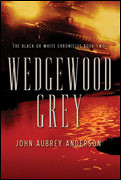
"Wedgewood Grey, The Black or White Chronicles Book Two," Exciting new Christian thriller by John Aubrey Anderson. 2007.FaithWords
One bleak night, in the middle of a wet April in a 1960s Mississippi community, evil is aroused. In the dark stillness of midnight, an innocent black woman is attacked by a mob of white men. Mose confronts the men from behind his twelve-gauge shotgun, and people die.

In 1962, an old black man and his grandson move into the country near Pilot Hill, Texas. He and the 10-year-old boy are fugitives, running from the certain injustice they know they'd receive from a justice system that will hold them liable for killing two white teenage boys determined to kill them. And, Mose and his grandson are fleeing something else, something more terrifying.

Missy Parker Patterson, who as a child stood at the epicenter of the first demonic war at Cat Lake, returns in the aftermath that follows Mose Washington’s disappearance to discover that the demonic beings have been anticipating her return . . . and so begins the second battle of The War At Cat Lake.

Wedgewood Grey is a story about the impact our choices make in our lives and the lives of those around us, when we choose between good and evil--choices that real people are sometimes forced to make.

Anderson's novels, "Abiding Darkness" and "Wedgewood Grey," are receiving good reviews. I'm currently reading "Wedgewood Grey" and find that I can't put it down. It's fast paced and filled with characters I've quickly learned to care about, and some I hope never to meet.

You can read the first chapter of the novel that begins this supernatural thriller series, "Abiding Darkness," at FIRST

Read more reviews from CFBA's Reviewer List and at Infuzemag
"Wedgewood Grey," Anderson,Amazon.com ISBN: 0446579505

Tuesday

Take a Writing Quiz Using AP Style

"Mastery of the language -- from the rules of grammar and punctuation to the nuances of meaning -- is the basic skill necessary for good copyediting and headline writing." Take the test, then find more writing help at JProf.com

Select the correct answer according to AP Style book:

1. V-J Day and V-E Day can be used vice-a-versa; that is, they are used interchangeably for the end of WWII.
a. Change V-J Day and V-E Day to V.J. Day and V.E. Day
b. Change vice-a-versa to vice versa
c. Both a and b.
d. No changes, correct as written.


2. Both the Mississippi and Missouri Valleys lie on the 25th parallel along with Virginia, the Virgin Islands and Vietnam.
a. Change Mississippi and Missouri Valleys to Mississippi and Missouri valleys.
b. Change the Virgin Islands to The Virgin Islands
c. Change Vietnam to Viet Nam.
d. Both a. and c.
e. Correct as written.


3. The very Reverend Jesse Jackson vied for a videotex data system belonging to Vermont’s chapter of the Veterans of Foreign Wars.
a. Change The very Reverend Jesse Jackson to The Very Reverend Jesse Jackson.
b. Change Videotex to either videotext or teletext.
c. Change Vermont’s chapter of the Veterans of Foreign Wars to Vermont’s chapter of the VFW.
d. Correct as written.


4. Dr. Vandyke said Vitamin B-12 and Valium are effective in the fight against vulgar venereal diseases.
a. Change Vitamin B-12 to vitamin B-12
b. Change Valium to valium
c. Both a. and b.
d. Correct as written.


5. The Viscount preferred a Victrola verses a videocassette recorder, or was that vice versa?
a. Change Viscount to viscount
b. Change Victrola verses a videocassette recorder to victrola vs. a VCR.
d. Change verses to versus
e. Correct as written


6. In Vietnam's villages, the Vietcong preferred vienna bread, vienna coffee and vienna sausages to vitamin A shipments from Virginia.
a. Change Vietcong to Viet Cong
b. Vienna should be capitalized in all cases.
c. both a and b
d. Correct as written.


7. Volkswagen of America, Inc.'s stockholders gave its company’s vice president VIP treatment when they presented him with a company VTOL.
a. Change Company’s vice president to company’s Vice-president
b. Change VIP treatment to very important person’s treatment as first reference.
c. Change VTOL to vertical takeoff aircraft because VTOL is acceptable only on second reference.
d. both b. and c.
e. Correct as written


8. Volunteers in Service to America thought Vice President Al Gore’s vote-getting tabulating amounted to the same thing as “voodoo economics” or so one VISTA member voiced while viscerally vying for Vandyke’s bottle of Valium and vitamins.
a. Change Volunteers in Service to America to VISTA because the full name is never used.
b. Change Vice President Al Gore to Al Gore, VIP, since he is no longer the vice president.
c. Delete One VISTA member voiced vernacularly—because she shouldn’t be voicing anything vernacularly, especially about Al Gore’s vote-getting tabulating! The idea of it! Hmmp!
e. Delete One VISTA member voicing vernacularly on any subject about the former VIP Al Gore; she should be ashamed of herself for her audacity, and for taking poor Viscount Vandyke’s bottle of Valium. It ought to be illegal.
f. Change nothing, it's beautifully written.

Answers to be posted as soon as I find them.....

Saturday

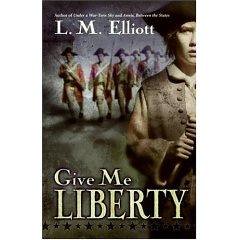
“Give Me Liberty,” by L. M. Elliott.


Nathaniel Dunn, an 11-year-old boy, arrives in America to find his new world filled with hardship and loss. His mother dies of ship fever, and his father abandons him, selling himself and son Nathaniel into indentured service to pay their passage.

On the Virginia plantation where he serves, Nathaniel gains a friend—Moses, an African slave. Moses looks after Nathaniel, and Nathaniel teaches Moses the alphabet.

The plantation master declares bankruptcy and sells everything, separating Nathaniel and Moses. A blacksmith buys Nathaniel’s contract at auction, then loses his temper and beats Nathaniel.

Basil Wilkinson, a school teacher, takes pity on Nathaniel, and sells valuable books to scrape together enough money to outbid the blacksmith for Nathaniel’s contract. In return, Nathaniel offers Basil his grandfather’s German flute, but Basil teaches him to play it.

Nathaniel goes to Williamsburg to live with Basil. He begins an apprenticeship to a Williamsburg carriage house where he meets Ben, a young idealist. Conflict develops quickly and the reader roots for Nathaniel and his friends as the carriage shop becomes caught up in opposing Loyalist and Patriot sympathies.

"Give Me Liberty," an historical novel written for age groups nine and up, is an excellent supplement to social studies curriculum, adding rich detail of daily life in Colonial America.

Elliott captures the struggle of the era through her portrayal of common people living out their lives in a period of social upheaval. Her characters display a strong sense of loyalty mixed with desire for self-determination. Nathaniel questions whether the revolution fueled by Patrick Henry’s words, “Give me liberty or give me death,” will apply to slaves like Moses:
“If Moses is fighting for the British to secure his liberty, something wasn’t right with the patriot cause.”

Elliott’s style is fun to read and filled with delightful descriptions such as this of Basil: “He was an angular, older man, all elbows and knees it seemed, like a grasshopper…., and his eyebrows were hairy and a bit wild, sticking almost straight up.” Readers who’ve had the pleasure to know Latin teachers can easily imagine Basil’s mixture of humility and wit.

An added bonus, Elliott includes period English lyrics “borrowed” by the Colonist’s and reworded as Patriot songs.

In a touch of irony, Ben, a zealot—but a poor-student—is wounded before he’s called to fight. Through Basil, he learns the value of words to support the cause; while Nathaniel—a good student—decides to fight alongside Basil as Patriots. Ben says to Nathaniel: "You’re stronger than you think, Nat; I’ve learned that steady men make better leaders.”

“Give Me Liberty” raises important issues for classroom and home school discussions. Neighbors, good and honest people, find themselves on opposing sides of the Revolutionary War; and many question the morality of slavery’s continued existence in colonies fighting for liberty. Guided by Basil, Nathaniel and Ben grow in wisdom and character, each adopting for himself Thomas Jefferson’s vision of the inherent “nobility of common man.”


Read More about L. M. Elliott
L. M. Elliott Essay, HarperChildrens Reading Group Guide PDF, Elliott on Reenacting,
Revolutionary War Reenacting Brigade

Give Me Liberty,” L. M. Elliott, HarperCollins Children's Books, 2006. ISBN:0060744219.

Elliott has written two YA historical novels, “Annie, Between the States,”

and “Under a War-Torn Sky"

Friday

Book Review: The Freedom of the Soul, by Tracey Bateman

Book Review: The Freedom of the Soul by Tracey Bateman

The Freedom of the Soul is Tracey Bateman’s second book in the Penbrook Diaries. It follows The Color of the Soul, which introduces the series’ characters. Color tells the story of a black newspaper reporter, Andy Carmichael, and his struggle to lead a life of hope and dignity, while safeguarding his young family from the inhumanities foisted on black families living in pre-Civil Rights Georgia.

In The Freedom of the Soul, Bateman probes the dynamics of human relationships between black and white Georgia, during the height of Jim Crow excesses. Carmichael returns to Oak Junction to cover the trial of a powerful state senator’s son, Sam Dane, Jr. Dane is accused of ordering the Klan-murder of an interracial couple; the young woman was Carmichael’s niece.

Underscoring these incendiary events, all characters are acutely mindful of the familial ties between the Carmichaels and Danes: Sen. Dane is Andy Carmichael’s biological father. One hundred years after freedom, black and white descendents of Penbrook plantation have inherited the consequences of their ancestors’ selfish passions — as well as their sacrificial love — woven between the barriers of slavery, fear, and racial hatred.

Meanwhile, out in Oregon, Shea Penbrook attends her grandfather’s funeral. Alone, she returns to the dilapidated farm house she’d shared with him—her last living relative. While rummaging through boxes in the attic, Shea discovers her family’s secret, buried for more than a 100 years in the pages of diaries written at Penbrook plantation by her great-great-grandfather. She decides to return to Georgia in search of love, family, and acceptance.

Tracey Bateman is more than a historical romance novelist. She tackles honestly the uncomfortable issue of race relations of the recent-past, relations that in some communities may not be the past at all. Bateman writes about the harsh judgment experienced by those who dared to cross society's racial taboos, judgment meted out by those who categorize human hearts along racial lines.

Bateman weaves her story seamlessly, as characters in the 1840s live out their lives on the pages of Freedom, alongside but never intruding on the 1940s characters that live with the awful price exacted on innocent lives for the sins of selfish, hate filled men and women.

On a lighter note, Bateman hooked me with her "Dear Readers" introduction letter to Freedom, where she tells of an ancestor who ran away to Mexico to marry a young slave woman who'd nursed him back to health. Readers, like me, who enjoy historical romance novels written from a Christian perspective, will love the Penbrook Diaries. I highly recommend both novels.

Wednesday

Blog Tour of If the Shoe Fits by Mailynn Griffith

This week Christian Fiction Alliance showcases IF the Shoe Fits," by Marilynn Griffith, prolific Christian romance novelist.
Marilynn Griffith is wife to a deacon, mom to a tribe and proof that God gives second chances. Her novels include Made of Honor (Steeple Hill, Jan. 2006), Pink (Revell, Feb. 2006), Jade (Revell, June 2006), and Tangerine (Revell, January 2007). Marilynn also writes for Chicken Soup for the Christian Woman’s Soul, Cup of Comfort Devotionals and her Shades of Style series, (Revell, 2006).
Marilynn lives in Florida with her husband and children. To book speaking engagements or just say hello, email: marilynngriffith@gmail.com Marilynn's blog: rhythmsofgrace

Have Glass Slipper, Need Prince....(don't we all?)

If the Shoe Fits is the second book in the Sassy Sistahood Novels. The first in the series was Made of Honor (Steeple Hill, Jan. 2006).
"In all my thirty-five years, I, shoe designer Rochelle Gardner, have never had so many men interested in me! My teen son's dad is back in my life after suffering from amnesia (yes, really). The church deacon has had his eye on me for years (and never said a word). And the young waiter (from the restaurant I've visited for singles' events) is trying to steal my heart. I've been struggling with my faith, trying to figure out which man God has chosen for me and wondering if I have the courage to step forward, on my not-so-pretty feet, to accept love. It's almost too much for the Sassy Sistahood to handle, but my girlfriends always have my back!"

Marilynn Griffith's novels are heart-warming and hilarious! Underneath the outrageous situations the Sassy Sistahood finds itself in, Marilynn weaves the truth of God's love and grace.
You'll enjoy If the Shoe Fits."

---------------------
Be sure to check out the The Bookshelf Reviews 2.0: The Compendium. Kevin, Lauren, and Kris will be reporting on the latest in fiction.

Thursday

Book Notes

These books are excellent. I Highly Recommend them!

Coming February 2007 : It happens Every Spring, by Gary Chapman and Catherine Palmer, Tyndale House, ISBN 1-4143-1165-6 TyndaleFiction
The promo says, "The Four Seaasons fiction series based on the ever-changing cycles of relationships detailed in Gary Chapman's nonfiction book, The Four Seasons of Marriage. The novels will focus on four couples, each moving in and out of a different season."
I'm reading this now and looking forward to writing a full review of this excellent book! Stay tuned.

Give Me Liberty, by L.M. Elliott, Katherine Tegen Books, HarperCollinsChildrens ISBN: 978-0-06-074421-2. Liberty is written for ages 9 and up, appropriate for forth grade through middle school readers, but, I am enjoying this book immensely. Elliott's research vividly presents life at Williamsburg on the eve of the American Revolution. I love her descriptions of their food and contemporary songs.

Then Came Faith, Book One, by Louise M. Gouge, published by Emerald Pointe Books. ISBN 0-97851-372-X. Gouge, author of five novels including Hannah Rose, and winner of numerous awards for her fiction, shows the struggles Christians dealt with over slavery: She "skillfully positioned the protagonists in thought-battles," giving the reader insight into the struggles of "conflicting religious convictions" held between northern and southern Christians. Available at local bookstores or contact: Emerald Pointe Books, Attention: Editorial Department P.O. Box 35327 Tulsa, OK 74153.

The Scarlet Trefoil, by L. A. Kelly, 2007, published by Fleming H. Revell, Baker Publishing Group, Grand Rapids, MI. ISBN: 0-8007-3156-5, List price $12.99. 304 Pg. Best known as Leisha Kelly, she is the bestselling author of Julia's Hope, Emma's Gift, Katie's Dream, Rorery's Secret, and Rachael's Prayer. Excellent historical/romance fiction.

Remember to Forget, a novel, by Deborah Raney, 2007, Howard Books Publishing, www.howardpublishing.com ISBN: 1-58229-643-X, List price $12.99. Christian fiction/romance. Raney is the award-winning author of several novels, including A Nest of Sparrows and the RITA Award-winning Beneath a Southern Sky, and its sequel, After the Rains. Raney is known for her sensitive portrayal of family struggles and relationships.

Death, Deceit and some SMOOTH JAZZ, An Amanda Bell Brown Mystery by Claudia Mair Burney, 2007, published by NAVPRESS, Colorado Springs. ISBN 1-57683-979-6. Burney is the author of Murder, Mayhem and a Fine Man. www.navepress.com